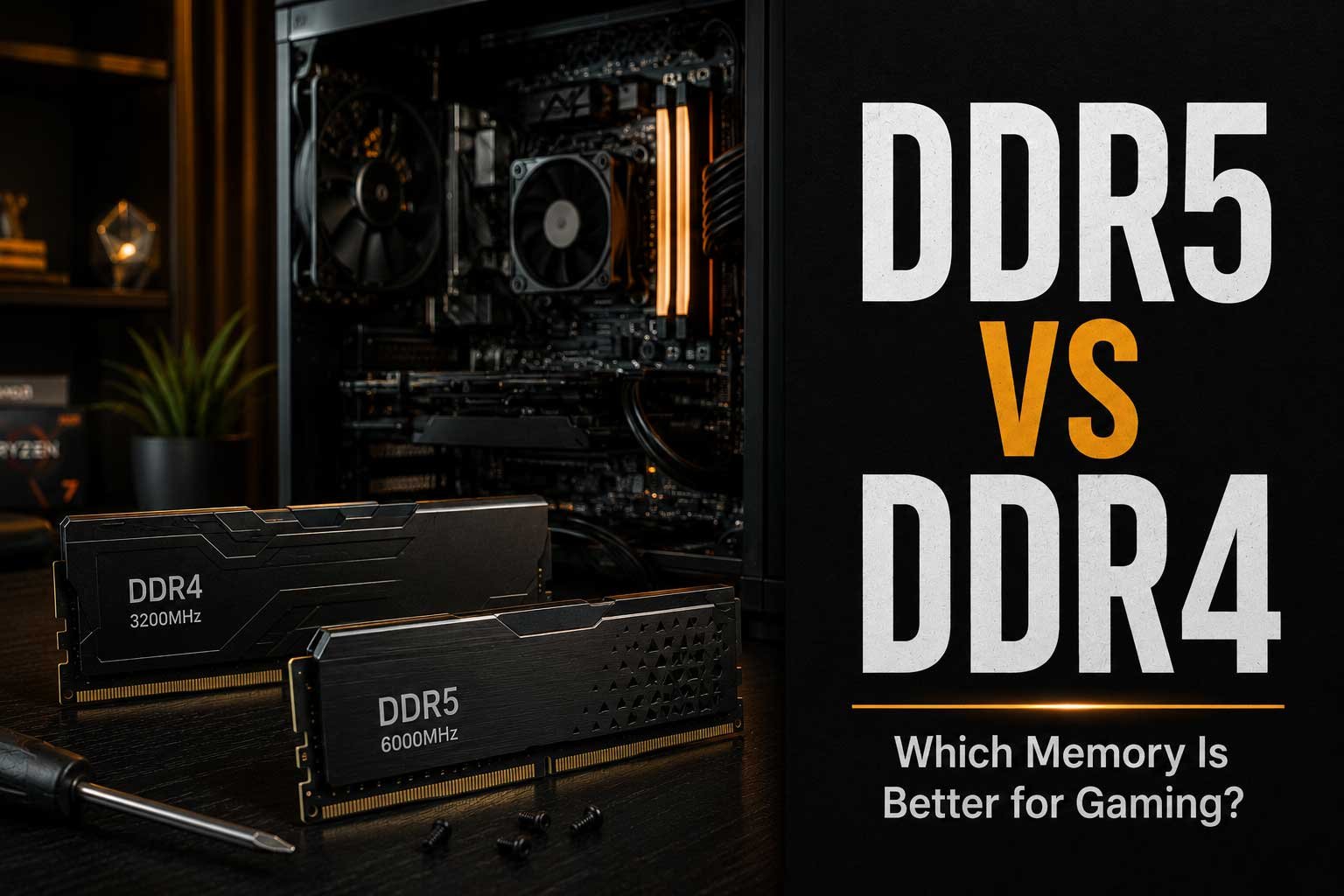
DDR4 and DDR5 are both widely used memory standards, but how much difference does the newer technology actually make? In this article, we look at:
- Key differences between DDR4 and DDR5
- Real-world gaming performance
- Memory speed, latency and bandwidth
- Price differences between DDR4 and DDR5
- Which platform offers better upgrade potential
- Is DDR5 worth choosing for a new gaming PC?
DDR5 vs DDR4: Is the Difference Noticeable in Gaming?
DDR4 has been the standard memory choice for gaming PCs for many years, but DDR5 has now become the preferred option for newer platforms. At first glance, the difference can look simple: DDR5 offers higher speeds and greater bandwidth, while DDR4 is generally cheaper and still capable of delivering good gaming performance. In reality, the choice depends on the rest of the system, the games you play and whether you are building a new PC or upgrading an existing one. In this comparison, we look at the practical differences between DDR4 and DDR5, including gaming performance, latency, pricing, platform compatibility and future upgrade potential.
What Is the Difference Between DDR4 and DDR5?
DDR4 and DDR5 are different generations of system memory, and they are not interchangeable. DDR5 was designed to provide significantly higher memory bandwidth while also improving efficiency and capacity potential. DDR4 commonly operates at speeds such as 3200MT/s, while DDR5 kits can operate well above 6000MT/s on modern platforms. DDR5 also uses a different memory architecture, including two independent 32-bit channels per module rather than a single 64-bit channel. This helps improve how memory requests are handled and contributes to the higher bandwidth available with DDR5. However, higher memory speed does not automatically mean that every game will run dramatically faster. The actual benefit depends heavily on the CPU, GPU, game engine and resolution being used.
DDR5 vs DDR4 Gaming Performance
For gaming, the performance difference between DDR4 and DDR5 can range from relatively small to noticeable depending on the system. Games that are heavily dependent on CPU performance can benefit more from faster memory, particularly when targeting high frame rates. In CPU-limited situations, DDR5's additional bandwidth can help the processor access and process data more efficiently. However, when a game is primarily limited by the graphics card, changing from DDR4 to DDR5 may produce a much smaller improvement. This is why a faster memory standard should not be treated as a replacement for a more powerful GPU. Our previous article CPU vs GPU: What Makes a Game More Demanding? explains why different games can place very different demands on your hardware.
Memory Speed and Latency
One of the biggest differences between DDR4 and DDR5 is memory speed. DDR5 can provide considerably higher transfer rates, increasing the amount of data that can move between the CPU and memory. However, memory speed is only part of the equation. CAS latency also matters, and early DDR5 kits often had relatively high latency compared with mature DDR4 memory. Newer DDR5 kits have improved considerably, especially popular configurations around 6000MT/s with sensible timings. This means that simply choosing the kit with the highest advertised speed is not always the best approach. A balanced combination of speed, timings, capacity and platform compatibility is generally more important than chasing the largest number on the specification sheet.
Does DDR5 Use More Power?
Despite its higher performance potential, DDR5 was designed with improved power efficiency in mind. DDR4 memory modules traditionally operate at around 1.2V, while standard DDR5 operates at around 1.1V. More importantly, DDR5 moves the power management circuitry onto the memory module itself, using a component known as a PMIC. This helps regulate power more efficiently and supports the higher speeds that DDR5 is designed to achieve. The difference in memory power consumption is not usually something that will dramatically change the electricity usage of a gaming PC, but the architectural improvements become more relevant as memory speeds and capacities increase.
DDR4 Is Still Good for Gaming
Choosing DDR5 does not mean that DDR4 suddenly became slow or unsuitable for gaming. A well-configured DDR4 system can still provide excellent performance, especially when paired with a capable modern CPU and graphics card. If you already own a DDR4-based system and your games are running well, replacing the entire platform simply to move to DDR5 may not provide enough additional performance to justify the cost. This is particularly true if your current limitation is the GPU rather than the memory subsystem. Before upgrading, it is worth considering whether your existing hardware actually needs replacing. Our guide Why Your GPU Isn’t Reaching 100% Usage: Causes and How to Fix It can also help identify situations where a GPU is not being fully utilised.
DDR5 Is Better for New Builds
For a completely new gaming PC, DDR5 generally makes more sense than investing in DDR4 today. The main reason is not simply the immediate performance difference, but the platform compatibility and upgrade path. Modern CPU platforms increasingly focus on DDR5, while DDR4 is associated with older generations of processors and motherboards. Choosing DDR5 therefore gives a new system access to newer CPUs, faster memory configurations and higher-capacity kits without being tied to an older memory standard. This can be particularly important if you plan to keep your PC for several years. A new build should normally be evaluated as a complete platform rather than choosing individual components based only on their current price.
What About 16GB vs 32GB?
Memory capacity is another important part of the decision. The difference between DDR4 and DDR5 is often discussed in terms of speed, but having enough RAM can matter more than moving between memory generations. For many gaming systems, 32GB has become a comfortable target, particularly for modern games, multitasking and applications running in the background. A slower system with enough memory can sometimes provide a better experience than a faster system that is constantly running out of available RAM. We previously covered this topic in How Much RAM Do You Really Need for Gaming?, including why capacity should be considered alongside memory speed.
DDR4 vs DDR5 Price
Price is where DDR4 can still make sense, particularly when buying older compatible hardware. DDR4 memory kits can be inexpensive, and there are many established CPU and motherboard combinations available on the second-hand and budget markets. DDR5 has also become much more accessible than it was when it first launched, although prices can vary considerably depending on capacity, speed and timings. The important point is to compare the total platform cost rather than just the price of the RAM. If choosing DDR4 means buying an older motherboard and CPU, the initial saving may come with fewer upgrade options. Conversely, if you already own a compatible DDR4 platform, keeping your existing memory can be much more economical.
Which Is Better for Gaming?
If you are building a new gaming PC, DDR5 is generally the better choice. It provides higher bandwidth, supports newer platforms and offers a stronger long-term upgrade path. The performance improvement will not be identical in every game, but DDR5 gives modern CPUs the memory platform they are increasingly designed around. DDR4 remains a perfectly capable option for existing systems and budget builds where the overall platform cost matters more than having the newest technology. The decision therefore depends on your starting point. For an existing DDR4 PC that already performs well, upgrading the memory standard alone is rarely a priority. For a new system, however, DDR5 is the more forward-looking option.
DDR5 vs DDR4: The Final Verdict
DDR5 is not a revolutionary upgrade that will suddenly double gaming performance, but it is a meaningful improvement in the underlying memory technology. Its higher bandwidth, improved architecture and compatibility with newer platforms make it the logical choice for most new gaming PCs. DDR4 still has value when keeping an existing system running or building around older, affordable hardware. Ultimately, the best memory choice depends on the entire configuration rather than the RAM specification alone. A balanced CPU, GPU, motherboard, storage solution and memory kit will produce a better gaming experience than spending too much of the budget on one component. If you are building from scratch, however, DDR5 is the memory standard we would choose for a modern gaming system.