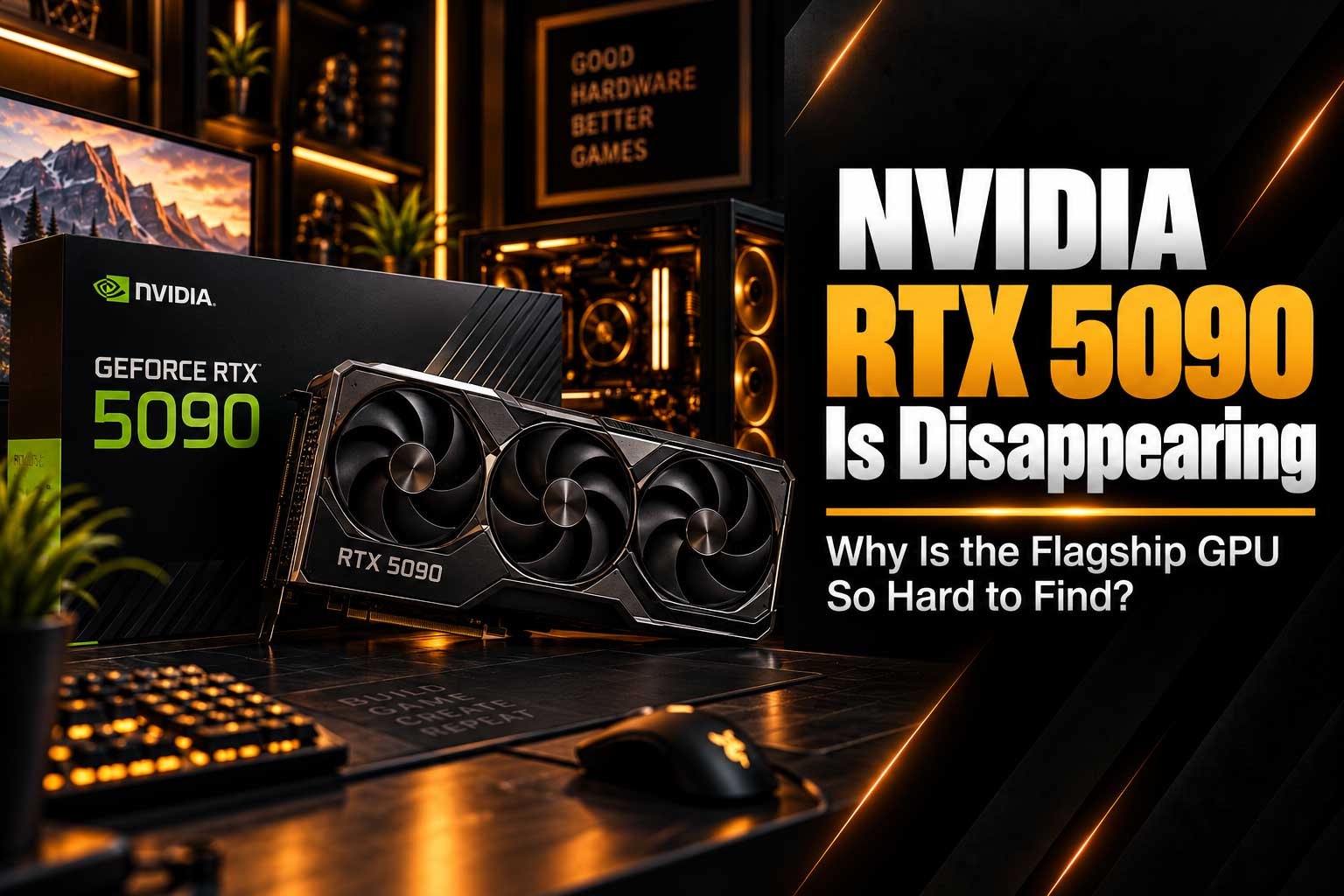
Why is the NVIDIA RTX 5090 becoming so difficult to find? This article explores the latest RTX 5090 stock shortages, availability, pricing, and the factors affecting the supply of NVIDIA’s flagship GPU.
- Why RTX 5090 stock is becoming harder to find
- What is causing the current RTX 5090 shortage
- How limited supply is affecting RTX 5090 prices
- How AI demand is affecting the GPU market
- Whether RTX 5090 availability could improve
- What the shortage means for PC gamers
- What RTX 50 Series alternatives are available
NVIDIA RTX 5090 Is Becoming Increasingly Difficult to Find
The NVIDIA RTX 5090 was launched as the flagship consumer GPU of the RTX 50 Series, but by September 2026 it has become increasingly difficult to find at normal retail prices. The situation is particularly noticeable in Europe, where recent listings show the cheapest new RTX 5090 cards moving well above NVIDIA's official European reference price of €2,099. In Germany, recent retail listings have been above €5,200, while individual models in other European markets have been listed at even higher prices. This creates a significant gap between the official RTX 5090 price and what buyers are actually being asked to pay. For PC gamers, the issue is therefore no longer simply performance, but also RTX 5090 availability, supply and rapidly changing market prices.
What Is Happening to RTX 5090 Stock?
The current situation goes beyond a single retailer temporarily running out of graphics cards. During September 2026, reports have shown RTX 5090 stock becoming increasingly limited across major online retailers, with some models appearing briefly before disappearing again. European stock trackers have recorded RTX 5090 cards returning to stores at prices exceeding €5,000, while other listings have quickly moved back to out-of-stock status. This does not mean that NVIDIA has officially stopped producing the GPU. Instead, it shows that the number of cards reaching normal retail channels is currently much smaller than the demand for them. Availability can also vary significantly between countries, manufacturers and individual models, making the European RTX 5090 market particularly difficult to track.
| RTX 5090 Market Factor | September 2026 Situation |
|---|---|
| European reference price | €2,099 for the Founders Edition |
| Recent European retail prices | Often above €5,000 |
| German market | Recent listings above €5,200 |
| RTX 5090 VRAM | 32GB GDDR7 |
| Availability | Limited and highly variable between retailers |
Why Is the RTX 5090 So Hard to Find?
There is no single publicly confirmed explanation from NVIDIA for the current RTX 5090 shortage. However, several factors are putting pressure on the high-end GPU market. The RTX 5090 combines NVIDIA's Blackwell architecture with 32GB of GDDR7 memory, making it attractive for demanding gaming as well as AI development, local machine learning and other GPU-accelerated workloads. Recent reports have also shown retail RTX 5090 graphics cards being purchased in large quantities for AI-related systems. At the same time, the wider memory market is experiencing significant supply pressure. These factors can contribute to fewer cards reaching traditional gaming retailers, especially while demand for high-end GPUs remains strong.
- Strong demand for high-end GPUs
- Growing demand for AI computing hardware
- Demand for GPUs with 32GB GDDR7 VRAM
- Competition between gaming and professional computing workloads
- Limited RTX 5090 retail stock
- Higher prices across parts of the European GPU market
Are AI Companies Buying RTX 5090 Graphics Cards?
One of the most interesting developments surrounding the RTX 5090 shortage is the growing use of consumer GeForce hardware for AI workloads. The RTX 5090 features 32GB of GDDR7 memory, which can make it attractive for certain local AI and machine-learning applications that require substantial VRAM. Recent reports have shown images of large quantities of retail RTX 5090 graphics cards being prepared for AI systems. This does not prove that AI companies are responsible for the entire shortage, and NVIDIA has not publicly confirmed that RTX 5090 production has been redirected specifically toward AI customers. However, the reports demonstrate how consumer GPUs are increasingly being used outside traditional gaming PCs, adding another source of demand to an already limited high-end GPU market.
RTX 5090 Prices Are Far Above the Official Price
The biggest consequence for European consumers is the growing difference between the official RTX 5090 MSRP and real-world retail pricing. NVIDIA's European reference price for the Founders Edition is €2,099, but recent European market observations have shown new RTX 5090 cards listed at around €4,600 and above. In Germany, some recent listings have exceeded €5,200, while individual premium models have been listed above €6,000. These prices vary considerably depending on the manufacturer, cooler design, retailer and country. They should therefore be treated as market observations rather than a new official NVIDIA price. The situation demonstrates why checking the actual retailer price, warranty and availability is particularly important when considering a RTX 5090 gaming PC.
| Price Reference | RTX 5090 Situation |
|---|---|
| NVIDIA European reference price | €2,099 |
| Recent euro-zone observations | From around €4,600 |
| Recent German listings | Above €5,200 |
| Some premium models | €6,000+ |
| Market situation | Prices substantially above the official reference price |
Is the RTX 5090 Being Discontinued?
There is currently no confirmed announcement that NVIDIA has discontinued the RTX 5090. A shortage of retail inventory should not automatically be interpreted as the end of production. Graphics card availability can change because of manufacturing capacity, memory supply, distribution decisions, regional demand and retailer inventory cycles. The current evidence instead points toward a supply and availability problem, with cards still appearing at European retailers but often at very high prices. For PC builders, the immediate issue is therefore RTX 5090 availability rather than an officially confirmed discontinuation. If a particular model is unavailable, paying several thousand euros through an alternative marketplace may be a very different proposition from waiting for conventional retail stock to return.
For buyers who want to understand why GPU memory matters, our previous article 8GB vs 16GB VRAM explains how different VRAM capacities can affect modern gaming. You can also read What Is VRAM and How Much Do You Need for Gaming? for a broader explanation of how graphics memory works.
What Does the RTX 5090 Shortage Mean for PC Gamers?
For gamers building a new high-end PC, the current RTX 5090 availability problem makes the purchasing process considerably more complicated. The RTX 5090 remains NVIDIA's flagship consumer graphics card, but paying more than €5,000 for the GPU can dramatically change the total cost of a gaming PC. A shortage also affects system builders because the graphics card is often one of the most expensive components in a high-end configuration. If the exact GPU is unavailable at a reasonable price, buyers may need to consider another RTX 50 Series model or an alternative GPU platform. This is especially relevant for gamers who care about achieving a particular resolution and frame rate rather than simply owning the most powerful consumer GPU available.
- Check the actual RTX 5090 price, not only the official reference price
- Verify the retailer and seller before making a purchase
- Check the exact RTX 5090 model and warranty
- Compare alternative high-end GPUs
- Consider the complete gaming PC cost
- Look at the performance required for your target resolution
What About the RTX 5080?
The RTX 5080 is another high-end RTX 50 Series option for buyers who want strong NVIDIA performance without specifically targeting the flagship RTX 5090. It does not have the same 32GB VRAM configuration, but it sits below the flagship in NVIDIA's product range and can therefore be relevant when availability and total system cost are important. The current RTX 5090 shortage also demonstrates that the most powerful component is not necessarily the easiest component to build a complete system around. For buyers interested in an RTX 50 Series gaming PC, you can view the current CompHub RTX 5080 selection and compare available systems based on their specifications and configuration.
How Does RTX 5090 Availability Compare With Other GPUs?
The current situation is particularly noticeable because the RTX 5090 occupies the top position in NVIDIA's consumer GPU lineup. However, limited RTX 5090 stock does not automatically mean that every RTX 50 Series graphics card is equally difficult to purchase. Availability and pricing vary between GPU models, manufacturers and European markets. The RTX 5080 and RTX 5070 target different performance and price segments, while AMD's Radeon RX 9000 Series provides another high-performance option for PC builders. This means the current market should not simply be viewed as a general graphics card shortage. Instead, buyers should consider the specific GPU they need, its current price, the availability of complete PCs and whether the performance difference justifies the additional cost.
| GPU Segment | Main Consideration |
|---|---|
| RTX 5090 | Flagship performance and 32GB VRAM, but extremely high current retail prices |
| RTX 5080 | High-end RTX 50 Series alternative |
| RTX 5070 | Lower price and performance segment |
| Radeon RX 9000 Series | Alternative high-performance GPU platform |
Why GPU Availability Matters When Building a New PC
A graphics card shortage can affect much more than the GPU itself because the graphics card often determines the rest of a high-end gaming PC configuration. A system designed around an RTX 5090 may require a powerful CPU, suitable cooling, a high-capacity power supply and enough physical space for the graphics card. If the GPU suddenly becomes unavailable or significantly more expensive, the entire configuration may need to be reconsidered. Our guide Should You Upgrade Your PC or Build a New One? explains the wider considerations involved in upgrading or replacing a gaming PC. It is also worth looking at your target resolution and games before spending a significant amount on a flagship component.
Could RTX 5090 Stock Improve?
It is difficult to predict exactly when RTX 5090 stock will return to normal levels because NVIDIA has not provided a public timetable for stabilising current retail availability. Recent European listings demonstrate that cards are still reaching retailers, but prices and stock levels can change rapidly. More supply reaching conventional retail channels could eventually reduce the current premium, while continued demand from AI and other high-performance computing workloads could keep pressure on availability. Memory supply is another factor that may influence the wider GPU market. For European buyers, the important point is that September 2026 represents an unusually expensive period for the RTX 5090, with observed prices in several countries substantially above the official €2,099 reference price.
RTX 5090 and the Future of High-End Gaming PCs
The RTX 5090 shortage highlights how quickly the PC hardware market is changing. High-end gaming GPUs are no longer demanded exclusively by gamers. The same combination of powerful GPU compute, large amounts of VRAM and modern AI acceleration that makes the RTX 5090 attractive for gaming can also make it useful for local AI and other compute workloads. This creates additional competition for hardware that was traditionally purchased primarily for enthusiast gaming PCs. At the same time, technologies such as NVIDIA DLSS 5 are adding new capabilities to RTX 50 Series GPUs, increasing interest in the platform. The result is a high-end GPU market where gaming performance, AI demand, memory supply and retail availability are increasingly connected.
What Should PC Builders Take From the RTX 5090 Shortage?
The current RTX 5090 availability situation demonstrates why the official MSRP and the actual market price can be very different. NVIDIA's European reference price of €2,099 remains an important benchmark, but recent European retail observations show how limited supply can push real prices to €4,600, €5,200 or even higher. For PC builders, the more useful approach is to consider the complete system rather than focusing exclusively on the flagship GPU. If the RTX 5090 is unavailable at a reasonable price, another GPU may provide a more practical route to the required gaming performance. Our guide on what PC you need for 1440p gaming also explains why choosing hardware around your actual gaming requirements can be more useful than simply selecting the most expensive component.
- RTX 5090 European reference price is €2,099
- Normal RTX 5090 retail stock has become increasingly difficult to find
- Recent European listings have reached well above €5,000
- AI demand is one factor increasing interest in high-end GPUs
- Memory supply is another pressure affecting the wider GPU market
- The RTX 5090 has not been officially confirmed as discontinued
- Alternative RTX 50 Series GPUs remain relevant for new gaming PCs
Final Thoughts
The disappearance of the NVIDIA RTX 5090 from normal retail channels has become one of the most notable high-end GPU stories of September 2026. The card has not officially been discontinued, but finding one close to NVIDIA's European reference price of €2,099 has become increasingly difficult. Recent European market observations show prices around €4,600 and above, while some German listings have exceeded €5,200. The combination of limited retail supply, strong high-end GPU demand, AI-related demand and wider memory-market pressure has created a difficult environment for buyers. For gamers and PC builders, the situation is a reminder that GPU availability can be just as important as specifications. The RTX 5090 remains an exceptionally powerful GPU, but its current price and availability are now major factors when planning a high-end gaming PC.